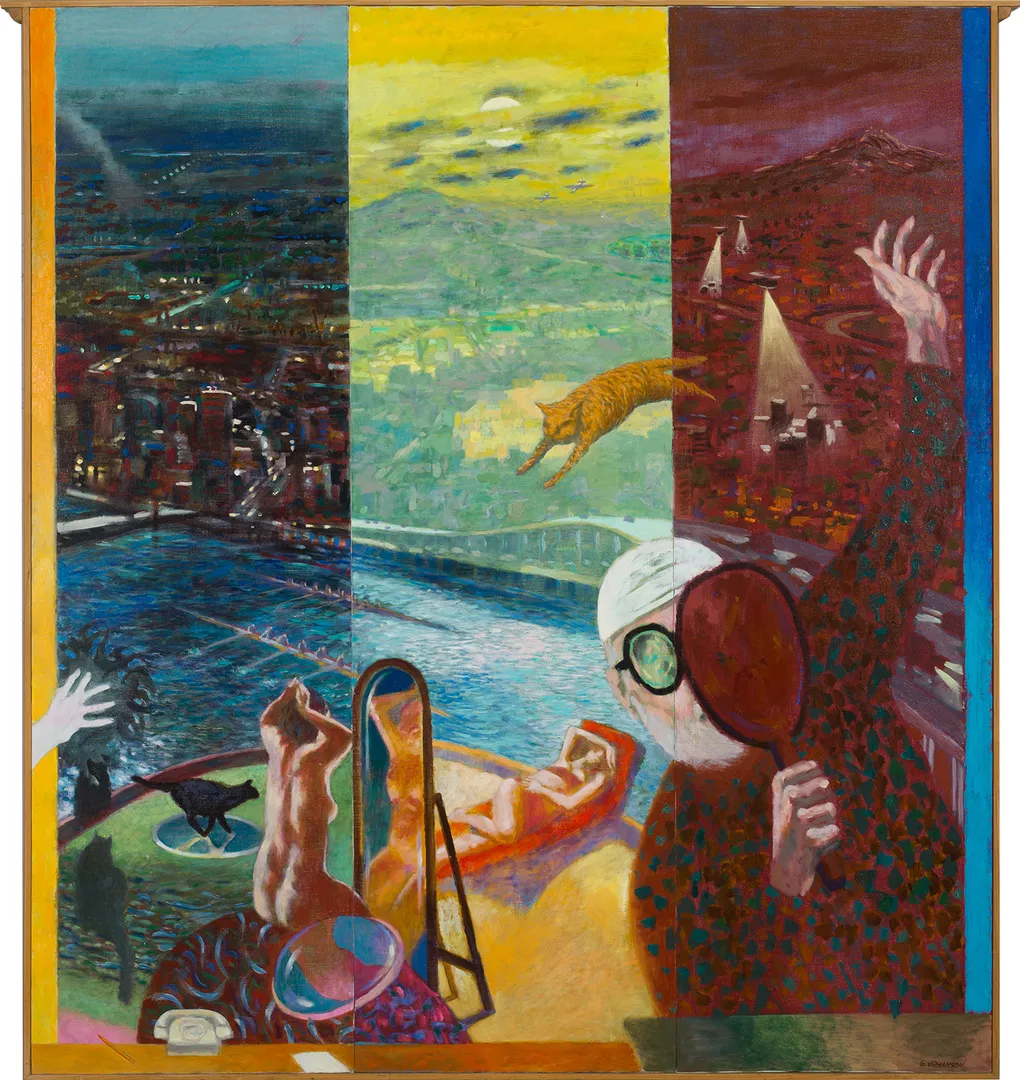
Born in Seattle, painter and printmaker George Johanson (1928-2022) moved to Portland in 1946 to study at the Museum Art School (now the Pacific Northwest College of Art), where he later taught for twenty-five years before retiring in 1980. Known for his kindness and generosity toward students and fellow artists, Johanson remained active in Portland's art community throughout a career spanning more than seven decades. He exhibited widely, and his work is held in major collections including the Smithsonian National Collection, the Portland Art Museum, and the Hallie Ford Museum of Art. He received the Oregon Governor's Arts Award in 1992. The Karin Clarke Gallery has previously presented large exhibitions of his prints; this is the gallery's first exhibition since his passing.
Where We Belong exhibit (March 18-May 16, 2026): The city of Portland, George Johanson's longtime home, occupies a central place in his work: "Practically everything I've done with landscape has been the city of Portland. […] I feel like I'm doing a portrait over and over again of the city," he once said. But these are not literal portraits. In this series of urban night scenes, imagination and fantasy play a key role, often through surrealist or expressionistic elements and touches of absurdism. Both formally and thematically, these compositions thrive on tension and contrast. In Nocturnal Mirrors, figures peer into multiple reflections of themselves, absorbed in a solipsistic world and oblivious to the surrounding cityscape. In his bus stop scenes, Johanson uses the shelter structure and patterns of light and darkness to partition space, heightening the sense of isolation among people waiting together yet lost in private thought. In Bus Stop #1, he overturns expectations by giving the figures a still-life quality while placing them within an environment alive with bright, clashing colors. The more minimalist Untitled composition evokes Edward Hopper in its quiet sense of separation within a shared space. Meanwhile, in Game Night, the explosion of artificial lights and swirling forms against the night sky give the place a mood of excitement that contrasts with the barely lit, inscrutable crowd.
-Sylvie Pederson